Welcome to Sonu Niigaam and Viviek

We welcome all the fans of Sonu Niigaam Ji here whole heartedly.
We are present here before you with more and more updates on the legendary singer. He is no doubts the King of Playback singing till date. We proudly present the best singer and the divine personality.
Keep logged in for updates..


One who makes a big deal of spirituality,seldom benefits from it!"Sonu Niigaam (160410 1305 Namah, in reply to a message from a friend)

Monday, March 15, 2010

Sonu Niigaam Ji coming up with 2 new chillax hits


Sonu Niigaam Ji sings 2 songs for JAANE KAHAN SE AAYI HAI  releasing on 9th of April....


                                      Crew

Cinematographer:
Story Writer:
Sound Designer:
Director:

                                     Music

Music Director:
Lyricist:


Track list :
01 - Keh Do Zara ~ Rashid Ali (05:01)
02 - Nacha Main ~ Sonu Niigaam, Soumya Raoh (04:53)
03 - Jaane Kahan Se Aayi Hai ~ Shaan (04:45)
04 - Koi Rok Bhi Lo ~ Sonu Niigaam, Sunidhi Chauhan (05:09)
05 - Jaane Kahan Se Aayi Hai (Remix) ~ Shaan (04:45)
06 - Keh Do Zara (Remix) ~ Rashid Ali (03:32)

Tuesday, March 9, 2010

Sonu Niigaam Ji at the launch of String Struck album !!

The iconic singer Sonu Niigaam Ji  was present at the launch of String Struck music album recently in Mumbai..

Other celebs present at the event were Jagjit Singh, Purbayan Chatterji, Shankar Mahadevan, Shweta Pandit.. 

http://indiainteracts.in/newplatform/35729/STRING-STRUCK-Album-Launch.html

Enjoy!!

Sonu Niigaam Ji speaks about His concerts ...

One of India's biggest Bollywood actors, stage performers and playback singers Sonu Niigaam Ji spoke to BBC Radio Sheffield's Mushtaq Tufail in March 2010 about his stage performances...


Sonu Niigaam Ji's interview

Sunday, March 7, 2010

Sonu Niigaam Ji snaps back at industry on copyright

After the much hyped spat between singer Sonu Niigaam Ji and producer Vidhu Vinod Chopra over royalty share for singers at the last Copyright panel committee meeting early this week, the singer bared his heart on a social networking site. Sonu Ji posted a note this morning talking about the copyright issue and suppressed state of creative artistes in the country. Read on-

--------------------------------------------------------------------


Wake Up India from the slumber - Sonu Niigaam
All the producers, director, composers, lyrics writers present in the meeting, are witness to the fact that I never spoke about singers to get 25 per cent Royalties. That's a misquote by the media. Its the composers and lyrics writer's royalties that are confiscated by the music companies 100 per cent, and all we all were proposing was a fair split where in the producer being the funder, gets 50 per cent and rest 50 per cent split between the composers and the lyrics writers! How much more fair anyone wants us to get when in the rest of the world, 100 per cent goes to the composers and lyrics writers.!! We are not even discussing singers at this point.!

My favorite actor, whom I consider like my spiritual elder brother, who is known to be fair generally,.. just proposed to someone secretively, “forget it....give these guys one per cent.....“ What a magnanimous contribution!! My favorite actor!!!! Wow!! God bless all of them. I have anyways decided to live outside this country, a country that is too shy to give its artistes, their dues doesn't deserve purists like myself!. No wonder Ravishankarji, Zakirbhai, etc live abroad. I only feel bad for the future artistes, who will have to be subjected to this feudalistic arm twisting, if proper amendments are not made now. And the people who treat music as prayer and not a glamour driven activity.. Wake up India from the slumber!!

Love,
Sonu Niigaam

Saturday, March 6, 2010

SO-NEW NIIGAAM Ji

Sonu Niigaam Ji is a less angry, more confident man today and he owes the transformation to a book


 Leafing through the pages of a book, Sonu Niigaam Ji looks up and says, "This is what changed my life forever." Authored by Richard Carlson, the title reads: Don't Sweat the Small Stuff… and it's all small stuff. Sonu Niigaam Ji recounts the eve of his 30th birthday, which he celebrated at the Miami airport, "I decided to gift myself something. I went to a bookshop and approached the lady at the paying counter with three books that I'd chosen. 'Nice choice,' she said, 'but you've got to try this one’, and handed me this book by Carlson. 'I'm not getting an extra cut on this one. It's truly brilliant!' she said. The three-and-a-half hour-long flight that followed reaffirmed all that I had known but had hesitated to believe. While reading this book, whenever I'd pause with a question, the answer would be right there in the following pages." 


AAGE SE RIGHT 
Sonu Niigaam Ji admits that as a kid, he would often observe others behave a certain way and would wonder why he acted differently. He says, "These questions remained unanswered and childhood just passed me by. Born in a typical lower middle class family, we started keeping domestic help at home only 1993 onwards. I grew up saying thank you to anyone who would take my food plate away or offer to iron my clothes. From washing my own undergarments to picking up the utensils I ate in, I had always led my life a certain away. Some of my friends found it funny and I started questioning my habits, until decades later, I chanced upon this book. It didn't teach me how to treat my help as equals; it taught me to trust my own opinions. In one chapter, the author talks of sweeping the streets one fine morning, just to see what it felt like. This book redefined my naive definition of 'being cool'." 


AS GOOD AS IT GETS 
As for added advantages, the book seems to have worked wonders on Sonu Ji's temper too. He says, "While trying to become a singer, I encountered some of the worst people who tried to bully me, pull me down by calling me a 'baccha' in the industry, and the result was extreme anger and frustration. A chapter in this book told me how to picture things differently. The trick is to look at the person who you're angry with as though he/she were an infant. When you picture this, you realise how he too must have gone crying to his mother on being bullied by someone in school. The anger vanishes instantly. You're automatically 'above' him and that is an immense source of confidence." Sonu Niigaam Ji claims to have become a calmer person now. Earlier, things would affect him easily and would make him temperamental. He says, "Now, I've actually started driving my car not to reach from point A to point B but to enjoy the ride itself, despite the Mumbai traffic. Think about it. If you are not in a hurry, why treat every drive of your life as an ordeal?"


Friday, March 5, 2010

Sonu Niigaam Ji, now in the copyright panel ...

The ten member panel formed by HRD Minister Kapil Sibal is undergoing changes and is in the process of being restructured. The ministry is including members from different realms to make it balanced.
In the last meeting that transpired on Tuesday, 2nd February, four new members- singers Sonu Niigaam Ji, Jagjit Singh and directors- Ken Ghosh and Madhur Bhandarkar were added to the panel...


T-Series head honcho Bhushan Kumar says, “The copyright amendment came as a shock for the industry as we were not consulted before proposing the amendment. We are in talks with the composers, lyricists addressing the limitations of the proposed amendments.”

Music composer Ram Sampath who was part of the earlier panel and is no longer a member mentions, “The panel has been re framed according to call taken by the ministry to add more writers, producers, composers.” Sampath has been replaced to include renowned lyricist Gulzar.
Says Sampath, “More members would be added to the panel as the consensus is to protect the musical heritage of India. The idea is to expand the ambit of members in the panel- it would now include musicians from the classical music, non-film genre and writers, musicians not essentially from the Bollywood sphere.”
The idea for a larger panel was mooted as the producers felt under represented and the members agreed amicably for expansion with balanced representation. Sources mention names like Shubha Mudgal, Ustaad Rashid Ali Khan, Pandit Shiv Kumar Sharma might sprung up to re frame the new panel...


Revealing the deadlock at the last meeting, Bhushan Kumar states, “We discussed the issue of non assignable rights with the composers and lyricists explaining them the drawbacks in adapting it. It would hinder revenue options for artists in far flung places as it is not feasible for labels to approach them every time they need to exploit the music.”

Terming the revenue share as unreasonable, Kumar says, “Music labels are not in a position to provide a revenue share to composers, lyricists without recovering the basic cost. Also, music labels invest in music looking at the star cast in the film and not essentially the lyricist and composer involved in the project. Without star pool, it is difficult to sell ringtones, music videos and the recovery is low.”

"I don't choose songs, Songs choose me --- Sonu Niigaam Ji"

One of India's biggest Bollywood actors, stage performers and playback singers Sonu Niigaam Ji spoke to BBC Radio Sheffield's Mushtaq Tufail in March 2010 about HIS stage performances...


Sonu Ji says, "If you behave genuinely with me, I can give my life for you..."


Enjoy this Sonu Ji's exclusive interview...


http://news.bbc.co.uk/local/sheffield/hi/tv_and_radio/newsid_8548000/8548082.stm

Thursday, March 4, 2010

Sonu Niigaam Ji's Rotterdam Interview Part - 1

Sonu Niigaam Ji's Rotterdam Interview Part - 2

Sonu Niigaam Ji's Rotterdam Interview - Part 3

Sonu Niigaam Ji before the concert - Netherlands, Ahoy (Rotterdam, Holland)

[Interview+-+Netherlands,+Ahoy+(Rotterdam+Holland)+27-02-10.jpg] 
Sonu Niigaam Ji before his concert in Rotterdam. In the first part of the interview, the singer talked about the copyright issues that have recently been raised in Bollywood. Writers, composers and lyricists want to make amendments to the current copyright act of 1957. According to this act, they do not get any royalties for their songs for the years to come. While producers and music companies are making money, these talented and integral parts of the music produced in Bollywood have to fight for their rights to this money. India is the only country that doesn't honour them; everywhere else in the world, all the parties behind a musical piece get royalties for their contribution.
Sonu Niigaam Ji explained that he met with Aamir Khan last week before his trip to Holland to talk about this issue extensively. Aamir recently said that actors are the ones who are the real stars and they are the ones who make the songs hits, irrespective of good lyrics or tunes. Sonu Niigaam Ji didn't like the comment and decided to talk to him about the issue. "Aamir is a good friend of mine and I love him very much, that is why I went to talk to him."

In our interview with
Sonu Niigaam Ji he said it is an old tradition in our country that one guy sings and the "star" lip-syncs. This doesn't happen in any other country. Sonu Niigaam Ji added that he told Aamir that if he feels this way, he should stop using songs in his films. "Every film is promoted by using the songs. Aamir wanted to understand but he doesn't know that in the whole world, there isn't one country that has the same policy that is being used in India. Music industries are a separate business."

According to
Sonu Niigaam Ji, Indian films shouldn't have songs. Because of the Hindi film songs, the private music industry isn't doing well. "There is no independent music industry in our country because of film music. Film music has killed ghazals, has killed classical, has killed any other kind of pop music or bhangra music or whatever."
Sonu Niigaam Ji is fighting for these copyright amendments being made. "Actors and producers of course have their own reasons for not letting this happen, because when the amendments are made they are going to lose a lot of money. But it is not only a money issue, it is more about what is right and what is wrong." He added that many people are involved in making one song. There are singers, actors, composers and lyricists, but sometimes the credit only goes to the actor. "Also most of the money earned by sales of the audio CD goes to the music company. In our country the credit mostly doesn't go to the musicians, but to actors, producers and directors.

He said that in the whole world there is this rule, that composers and lyricists get royalties of the songs they compose and write. "Only in India this doesn't happen." He spoke about the wife of composer Khemchand Prakash. "She has died while begging in front of a radio station, because they didn't get any royalties. That is why we want everyone to get royalties. So that we don't have to worry about our old age, because we will be ensured of an income."

When Sonu Niigaam Ji and Biddu Appaiah met ...

[Sonu+Niigaam+&+Biddu+!!.jpg]There's one incident which Biddu hasn't mentioned in the book, though he wished he did. “It was quite some time back. I met Sonu (Niigaam) the first time at Holiday Inn in Mumbai. We were sitting at the restaurant and I saw an attractive girl wearing jeans and tattered T-shirt walk past. She was with an older man who could have been her dad. Just when she was leaving, Sonu told her ‘I love your films'. She smiled and turned towards me and said, ‘I love your music. I am a big fan.' I asked her, ‘What's your name?' She replied, ‘Madhuri.' ‘What do you do?' I asked her. ‘I act,' she said, ‘...in films.' 


After she left Sonu told me she was Madhuri Dixit. Madhuri Dixit! I felt like such an idiot!”

Sonu Niigaam Ji's latest songs in the movie Appu & Pappu

[Breaking+News+-+Sonu+Niigaam+Sings+For+Appu+and+Pappu.jpg]


After a month-long shooting schedule in Cambodia, the cast of ‘Appu and Pappu’ returned to the City and shared its experiences !


The team members of Appu and Pappu were excited on finishing their 35-day-shooting in Cambodia with an orang-utan. To share their shooting experiences, the team organised a press conference in a city hotel recently.

The director of the film is R Anantha Raju and the producer is Soundarya Jagadish. For the first time in Kannada cinema, an orang-utan will play the lead role. At the conference, Jagadish said, “The shooting of the film was supposed to start in November but we could not find an orang-utan, which is the lead character in the film. We visited Malaysia, Indonesia and Thailand in search of a trained orang-utan but finally got one in Cambodia.

The shooting went well beyond our expectations and the ape co-operated in every way.”
“We were jealous as there were six trainers, two doctors and two managers to look after the ape. Although, initially we were afraid to touch the orang-utan, we felt sad later to bid farewell to this companion,” he said.

Director Anantha Raju described the journey as a thrilling experience and appreciated child artiste Snehith. “While veteran actors were afraid to act with the huge ape, Snehith became a friend of the orang-utan in no time,” said the director. “The film is not just for children, everyone should see it,” he said.

Actor Abbas, who is back in Sandalwood with the film, said, “When I went through the script, it sounded good, and I became part of it. I enjoyed each and every moment on the set as well as off it.” Hamsalekha, who scored music for the film, said, “I have composed five melodious songs, exclusively for the film, and
Sonu Niigaam Ji and Shankar Mahadevan have crooned a song each in their rich voice.”

The story revolves around a boy and the orang-utan. Producer Soundarya Jagadish’s son Master Snehith is playing the lead role. The film also features Rekha, Komal Kumar, Madhuri, Jennifer Kotwal, Rangarayan Raghu and others. Sixty per cent of the movie was shot in Cambodia and the remaining 40 per cent will be done in Bangalore. The film will be released in May.

Tuesday, March 2, 2010

Sonu Niigaam Ji with a new album...

An album with Sonu Niigaam Ji, a music company to call his own and a project with Hollywood percussionist Greg Ellis — Bickram Ghosh tells that about hitting out on a serious note.

What sparked this album with Sonu Niigaam Ji?

I met Sonubhai while recording the song Dhundo for Ashoke Viswanathan’s Gumshuda. There was a strong connection. He was looking at entering new territories and, career-wise, I find myself in the same mindspace I was seven years back when I was doing classical music and wanted to expand. After a few phone calls with Sonu, we started talking about an album. Both of us felt that the time we have as artistes has to be utilised. It’s not about success or having 12 films in the kitty but doing substantial work that’s not just for us but also for the cause of music.

What is the album about?

It’s a world music album. There are strains and ideas from almost every possible world music genre we do — Sufi, Latin, jazz. It’s ethnic sounds mingling with niche, semi-popular electronica elements. Sonu is doing the melodies and song compositions and I’m designing the rhythms. We’re trying to feature guest artistes on every track. Till now we have Greg Ellis as a guest rhythm player on his drum kit. He has been the main rhythm player for films like The Matrix series, Iron Man and The Wolfman. There’s also Viswamohan Bhatt on his Mohan Veena and Giuliano Modarelli playing Italian guitar. We’ve laid down the structure of four songs and are through with 30 per cent of the album. Most of the work is happening in parts in Mumbai.


SONU NIIGAAM JI ..............................................................
How is it different from other world music projects?

My previous albums have primarily been driven by Indian sounds. This time I’m bringing in sounds and ideas I’ve gathered while hanging out with other musicians. World music albums don’t always feature songs and rhythms and are more often instrumental. Here we have songs that are in Hindi, English and even Gujarati. Sonu Ji is trying to get on board some American rappers and African vocalists, too. And then there are floating vocals, minimal words and beats that one wouldn’t expect to drive a song. It’s not about loops but raw acoustic energy.

Who’s producing it?

Manisha Dey, who has produced most of my albums, is producing the yet untitled album under the label of a new music company Veecon Music. Ours will be their second product after Amitabh Bachchan’s Hanuman Chalisa.

Weren’t you starting your own music company?

Yes, and I just registered it 10 days ago. It’s called Melting Pot Productions and should be up and running in the next few months. We’re starting off as a music label and then will move into content for television, films, events and artiste management. It started with the idea of keeping my copyright to myself. I was inspired by Shubha Mudgal, who started her online company some years ago and is doing phenomenally well. It’s allowing me to move into a different space and look at a gamut of possibilities. The way forward may not be completely clear but the instincts are strong.

What about composing for films?

I’m not looking at film music as a way forward. I don’t enjoy it half as much. I’m happier making music that is an alternative to Bollywood. I’ve not enjoyed doing music for many of the Bengali films that I have done. I got into it under pressure, gave it a shot and realised I had wasted crucial time.

So films are off at present?

I’ve said no to around three film score offers in the past month. Tomorrow if Sooni Taraporevala offers me another film, I’ll probably jump at it because I had great fun working on Little Zizou but I was never set to become a music director and never will be. I’m on a certain musical journey where I’m happy if something I identify with comes my way. I’m 40, not 22, and I’ve been going through this change over the past year.

How would you describe this transformation?

I’ve minimised my so-called social activities. I hardly go for parties. It doesn’t matter how much of a celebrity I am. If I don’t do substantial work now, I’d have missed the bus. Cutting ribbons and showing my face is not a benchmark for me as a musician. I spent three or four hours every day doing that. Now I want to move away from it. People misunderstand me but I feel I’ve found my space over the past two months. I work like a madman now. Not flippant anymore.

What about your solo projects?

I’m working on a solo experimental album called Tabla Sphere but my solo work is on the backburner at present. I need to expand as a musician and collaboration is the best way to do it. I started the process a few months ago with Remo and what I’m doing with Sonu or Greg Ellis is far deeper. Greg and I are working on a separate project called Rhythm Voyage. It has Zimbabwean musicians, Sufi and classical singers.....

Cheers!!

Exclusive Video-Sonu Niigaam ji documentary series by times now.

Sonu Niigaam Ji - Voice of million hearts Part 2

Sonu Niigaam Ji - Voice of million hearts Part 3

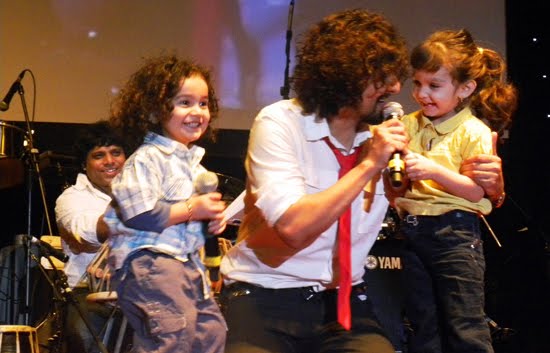
Angel Nevaan Performed live with his father Sonu Niigaam Ji

Sonu Niigaam
The Iconic singer, blessed with the golden voice, singing sensation performed recently at Khalifa Stadium, Doha, Qatar with his son Nevaan.

Nevaan just walking on the same track as his father did long time back. Very soon, the little angel will shine like the brightest star in the Music Industry.

Sonu Ji's tribute to Master Madan


Forgotten voiceMASTER MADAN


There has never been a singer like Master Madan who sang with a touch of the divine. There has been no effort to keep the memory of the child prodigy alive either in Jalandhar where he was born or in Shimla where he lived. Pran Nevile, who recently organised a concert as a tribute to Master Madan in Delhi, reconstructs the life of the maestro.

Master MadanI have been holding functions in Delhi to honour the great singers of yesteryear who brought popular music to the masses. Led by K.L. Saigal, these luminaries included Pankaj Mullick, Kannan Devi, Jagmohan, S.D. Burman, Malika Pukhraj, Begum Akhtar and others. Master Madan was a singer who created waves because of his gifted voice. When reminded by someone about the child prodigy, I set out to research his life and times.
Fondly remembered by music lovers all over the subcontinent for two eternal melodies Hairat se taq raha hai jahan-e-wafa mujheand yun na rah rah kar hamen tarsaiye, the child prodigy with his mature, perfectly modulated and unbroken voice created a sensation in the world of music. These two ghazals penned by Sagar Nizami still retain their magical appeal even after a lapse of over 70 years since they were recorded (1935). Those were the days of gramophone singers who brought music to the masses. The radio and the talkies were still in their infancy. Public concerts were immensely popular occasions where people flocked to hear leading singers from different parts of the country. Then there were the princely states from Mysore in the south to Patiala in the north, which extended their patronage and invited accomplished artistes to sing at their courts. Even at his tender age, Master Madan had cast such a magical spell on his listeners that in his day, he surpassed many a luminary of the music world in drawing crowds to his public performances.
Perfect performer
A file photo shows Master Madan with various musical instruments
No wonder, he received repeated invitations from princely states and the aristocracy who showered gold medals and presents on him. So much so, it is said that even Mahatma Gandhi who was on a visit to Shimla in 1940, could not attract the expected crowds at his meeting since on the same day there was a concert where Master Madan was singing. The crowds chose to listen to him.
Master Madan was born on December 28, 1927, in his ancestral village Khanekhana founded by Akbar’s courtier, Abdul Rahim Khanekhana, in district Jullundhur. During the British days this village was famous for its crafts especially ivory-inlaid wood work. It is said that Madan’s grandfather, Ram Singh, built a house there in 1928 called ‘Mohan Niwas’ where musicians often used to assemble for singing sessions but since the family settled down in Shimla/Delhi they seldom visited their village. His father Sardar Amar Singh was a Government of India employee working in the Department of Education, Health and Land in New Delhi/Shimla. He was himself a keen music lover and was quite good at playing the harmonium and tabla. Madan’s mother Puran Devi was a deeply religious woman and was responsible for Madan’s spiritual leanings from early childhood. His brother Mohan, 13 years older to him, was an accomplished singer and violinist.
Madan was a very handsome lad with deep-set eyes. Endowed with the appearance of a child-saint, he was raised in a musical environment and his sister Shanti Devi, 14 years older to him and an accomplished singer, taught him music from the age of two. Master Madan was amazingly quick in grasping the nuances of classical ragas and the intricate techniques of modulating the voice accordingly. He followed it up by learning from the eminent musician Pandit Amarnath, later a well-known composer of Bollywood, and Gosain Bhagwad Kishore.
Regular riaz
K.L. Saigal
K.L. Saigal
Along with his elder brother Mohan, he did his regular riaz (practice) with full devotion. Madan had his early schooling at Sanatan Dharam School at Shimla with his residence in New Bootele Building of Lower Bazar, which has been the family dwelling for nearly eighty years. Later, he passed his matriculation from the Ramjas School in Delhi and joined Hindu College. He was a bright student, but lost as he was in his devotion to music, he did not socialise much or participate in sports and other activities. According to contemporary accounts, he was always elegantly dressed in princely style, wearing gold chains, bedecked with medals and a shining turban.
It is learnt from authentic sources that when K.L. Saigal was working with Remington Typewriter Company in Shimla he often visited their house to meet Master Mohan, Madan’s elder brother. Saigal would bring his harmonium and both of them had long singing sessions with Madan (who was only two) attentively listening to them.
Shanti Devi has mentioned an unforgettable train journey from Kalka to Shimla with Saigal, Mohan and Madan. They had kept singing all the way, much to the amusement of the passengers. Later after Saigal had joined New Theatres Calcutta, he always looked after Master Mohan and Madan whenever they visited Calcutta. In fact, Saigal became very fond of Master Madan and admired his instinctive knowledge of music and his mastery in singing intricate classical compositions with perfect ease in his heavenly voice.
According to available records Master Madan gave his first public performance in June 1930 at the Dharampur Sanatorium. Then only three and a half years of age, he created a sensation and the audience was just wonderstruck on hearing his Hey sharda naman karun and another composition in Dhrupad. Not only did he receive a rapturous applause but the eminent classical singers present there pronounced that there was something unearthly in the gifted child as no such performance had ever been heard before and no one in India at that time could possibly match him. The news spread like wildfire all over the country and there was unprecedented media coverage with even the The Hindu of Madras carrying a photograph of Master Madan. Adored as a child prodigy, he soon became a cult figure and got invited to every major musical event organised in different parts of India. Shimla being his summer residence, he was a special favourite of the ruling princes of the hill states of district Shimla. As a result, Master Madan was always on the move along with his brother Master Mohan who was both a classical singer and a violinist. It is said that Master Madan was paid Rs 80 for a local performance and Rs 250 for an outstation concert. On an average he gave about 20 performances per month. However it was not his love of money that made him sing so much but more his devotion to music and the singing seemed to provide food for his inspired soul.